

(We continue our series on how we over-research and under-research which means we miss the opportunities to truly support family caregivers.)
It started at the federal level.
Robert F. Kennedy Jr., now leading the nation’s health apparatus, made clear that family caregiving — the work of 100 million Americans — did not register to him as work worth defending. He said Medicaid was paying family members to perform basic tasks they once did for free through programs he called “rife with fraud.” His comments opened a door. They did not create the dismissal. That dismissal was already built into the system, piece by piece, across decades of narrow research and incomplete counting. Kennedy gave it a megaphone. When a federal health official says the quiet part out loud, state lawmakers hear permission.
Ohio heard it. Colorado heard it. Maryland heard it. They are not the last.
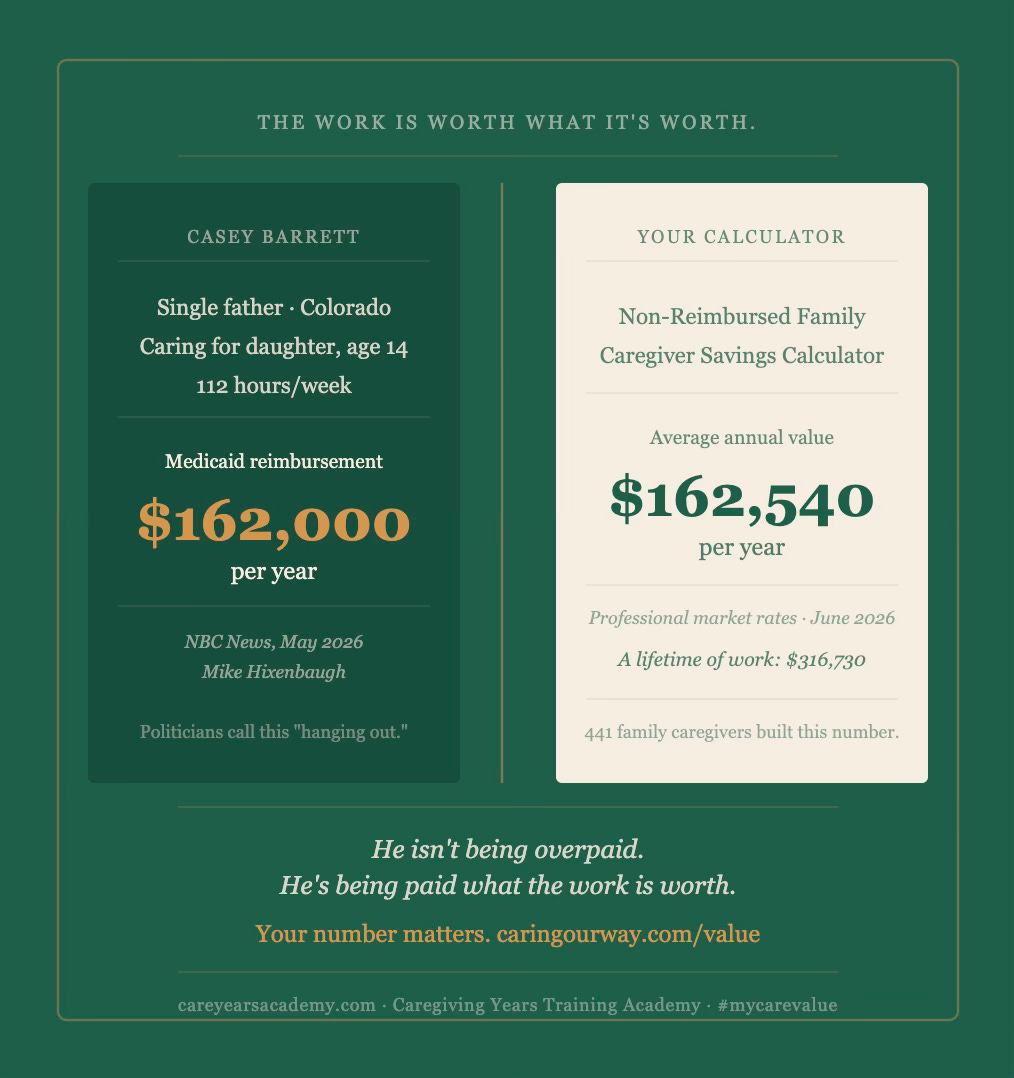
In May, NBC News reporter Mike Hixenbaugh documented what that permission already costs real families. Casey Barrett is a single father in Colorado. He earned his nursing assistant license and built his entire life around caring for his 14-year-old daughter, Olivia — tube feeding, diaper changes, constant monitoring for seizures and respiratory distress. He logs up to 112 hours a week. No clock-in. No clock-out. Under Colorado’s Medicaid home-care program, he earns about $162,000 a year.
Politicians call that “hanging out.”
Colorado’s new budget cuts cap reimbursable hours at 56 per week, which cuts his income to roughly $70,000 and threatens his ability to keep his mortgage.
“I would welcome anybody to come try. There’s no clock-in or clock-out. This is a continuous, nonstop job.”
— Casey Barrett, NBC News, May 2026
He shouldn’t have to issue that invitation. The work should speak for itself.
The Language Is Not Accidental
“Informal caregiver.” “Unpaid caregiver.” These are the terms the field uses. They appear in research papers, policy briefs, advocacy materials, and legislative testimony. AARP uses them. National Alliance for Caregiving (NAC) uses them. They are the accepted language of the field.
They call family caregivers “burdened” and “invisible.”
Take a look at a picture of Casey Barrett with his family and tell me the words you use to describe him include “burdened” and “invisible.” (Scroll to the bottom of the article for the photo.)
These terms — unpaid, informal, burdened, invisible — are the accepted language of the field.
They are also wrong.
We are not informal. Informal implies casual, occasional, unstructured. According to our data, family caregivers work 57.7 hours a week on average. They work across 32.9 distinct care types. They provide care that keeps people out of hospitals, nursing homes, and emergency rooms. There is nothing informal about it.
We are not invisible — we are interesting, multi-dimensional humans with a passion for quality of life.
We are not burdened caregivers. We are burdened by the systems.
We are not unpaid. Unpaid implies that payment is simply absent — an oversight, a gap, a policy not yet written. The reality is more precise than that.
We are non-reimbursed family caregivers.
Every other system that touches the person we care for receives reimbursement for its work. The hospital. The physician. The pharmacy. The home health agency. The managed care plan. The social worker. The physical therapist. Each of them bills. Each of them collects. Each of them has a code.
Family caregivers are the only system without a billing code while doing the work that makes every other system possible.
That is not informal. That is structural exclusion from the reimbursement system. The language that calls it “unpaid” makes that exclusion sound incidental. It is not incidental. It is the architecture of a policy environment that has always known we were here and chosen not to count us.
When the language is wrong, the defense is wrong. Right now, the defense is wrong.
The Field Can Only Defend What It Counts
When the attacks came — at the federal level, in Ohio, in Colorado, in Maryland, and in the legislative hearings now spreading to other states — the field responded. NAC wrote to Congress defending the Medicaid waiver program. AARP argued that “caregiving is work — and a Medicaid work requirement should recognize that.”
Both statements are true. Neither statement is enough.
NAC defended the program. AARP defended access to family caregiver’s own Medicaid health coverage not the full scope of their work. Neither organization defended the full scope of what family caregivers actually do because neither organization has fully counted it.
They can defend the personal care tasks the Medicaid waiver reimburses. They cannot defend the Worries — the hours spent awake at 2 a.m. running through what-ifs — because no Medicaid code exists for worry. They cannot defend the Being domain — the loss of identity, the grief without death, the self that caregiving slowly crowds out — because no research instrument the field relies on has ever asked about it. They cannot defend the Planning, the Advocating, the Communicating, the Sustaining — all of it invisible to the systems that look through a billing code window and call what they see the whole picture. (We define the work of family caregiver from these domains which form the Nine Domains of Caregiving.)
The definition determines the count, the number of family caregivers. The definition also determines who gets to be defended.
Because they don’t understand us, they can’t defend us.
This is not a criticism of NAC or AARP. Both organizations fight for family caregivers within the framework they have. The problem is a framework never built to hold the full scope of this work. When politicians look through that same narrow window and say “I don’t see work — I see someone hanging out,” the field has no answer that reaches beyond the window.
The attack works because the definition left us exposed.
What the Numbers Actually Show
441 family caregivers completed the Non-Reimbursed Family Caregiver Savings Calculator in the first 27 days after launch. They were not asked about their caree’s diagnosis. They were not asked to rate their burden on a scale of one to five. They were asked about their own experience — what they do, how much time it takes, and what it would cost if the market had to replace them.
Here is what they said:
Calculator Data — 441 Responses · 27 Days · June 2026
Average hours per week:
57.7Average years caregiving: 9.7
Average care types selected: 32.9 of 53
Average annual value: $162,540
Average lifetime value: $316,730
Total annual value across all 441: $71 million
Total lifetime value: $83 million
80.5% selected Worries as a care type. The Worries group averages 64 hours a week and $182,000 a year — more than double the hours and more than double the value of those who didn’t.
Casey Barrett earns about $162,000 a year caring for his daughter. Our calculator found that the average non-reimbursed family caregiver generates $162,540 a year in value at professional market rates. He isn’t being overpaid. He’s being paid almost exactly what the work is worth. Even that is now under attack.
Worry is not a side effect of caregiving. It is part of the work. And it has never appeared on a billing code.
This is not companionship. This is not hanging out.
Who fixes the errors the systems make? Family caregivers.
When the systems shut down for the day, who stays open? Family caregivers.
When the systems drop the ball, who picks it up? Family caregivers.
When the systems are a no-show, who shows up? Family caregivers.
When the systems stop funding a program that helps, who funds it anyway by replacing the work with their work? Family caregivers.
This is a workforce — skilled, experienced, working longer weeks than most full-time employees, generating economic value that dwarfs the Medicaid reimbursements now under attack.
The Value Gap
AARP’s research is now shaping how states identify family caregivers who qualify for Medicaid work requirement exemptions. The federal rule issued by the Centers for Medicare & Medicaid Services in June 2026 draws directly on AARP’s own research to help states build their frameworks. That research values the work of family caregiving at approximately $20 an hour, the rate of a home health aide.
Our calculator found something different. Across 441 family caregivers, the average hourly rate for the most complex care types is equivalent to $55 an hour — the rate of a care systems navigator. The difference between $20 and $55 is not a rounding error. It is the difference between counting the tasks and counting the work.
When states use AARP research to identify and value family caregivers using a 1997 definition and a home health aide rate, they see a fraction of the workforce at a fraction of their value. The states building their Medicaid frameworks right now will inherit both the definition and the rate. The family caregivers who don’t fit will remain uncounted. The work that exceeds a home health aide’s scope will remain unreimbursed.
This is not new. In 2018, at a conference I hosted, a large national organization — one you would recognize immediately — wanted to celebrate family caregivers by setting up a photo booth with signs for them to hold. The signs would have read: Cook. Chauffeur.
Not systems navigator. Not care coordinator. Not financial manager, medical advocate, or grief counselor. Cook and chauffeur.
They didn’t ultimately do it. But the instinct was there.
That instinct comes from the same place as the $20 hourly rate: organizations that see family caregivers as helpers doing discrete tasks rather than skilled people managing complex systems. The same organizations advising states in 2026 on how to identify and value family caregivers use a 1997 definition and a $20 hourly rate.
Different sign. Same instinct.
With better language, better definitions, and a more accurate measure of the work, we don’t value Casey Barrett at $20 an hour.
We value him at what the work is actually worth. The systems then protect his value because they understand they can’t operate without him.
What Kennedy Got Wrong and What the Field Got Wrong First
Kennedy did not invent the dismissal of family caregiving. He inherited a field that had been building it for decades.
When the research only measures burden, it produces a picture of family caregivers as stressed, depleted, and at risk. That picture is not false. It is incomplete. Stressed and depleted people who are also skilled, essential, and generating $162,000 a year in non-reimbursed value look very different from stressed and depleted people simply there because they happen to be family.
The research chose the first picture. It built instruments that asked: how much does this burden you? It built definitions that counted four tasks and called the rest informal. It built a policy environment where the full scope of family caregiving was never visible and then expressed surprise when politicians looked at the visible portion and said it didn’t look like much.
Kennedy said the quiet part out loud. But the quiet part had been written into the policy framework long before he arrived.
Michele Gregory and her husband care full time for their 31-year-old son, Nick, who has a rare and severe form of epilepsy. After they took over his caregiving, his hospitalizations dropped from about four times a year to once every 12 to 18 months. Gregory told NBC News that the change saved Medicaid somewhere between $300,000 and $400,000 a year.
The system saved that money because a family caregiver showed up. It is now cutting her income by more than $80,000.
The attack on family caregivers is only possible because the definition left them exposed. The definition was built by researchers, replicated by advocates, embedded in policy, and inherited by lawmakers who never had reason to question it because the field never gave them one.
Fix the definition. Count the work. Train the people who support us to start with who we are not what we’ve lost.
Then try to call it “hanging out.”
Next in Our Series: The Burden Scale Is a Burden
The instrument the field chose to measure family caregivers has been asking the wrong questions for 46 years. What it asks family caregivers to do — and what it costs them — is the subject of our next part.
What’s Your Value?
When you calculate your value as a family caregiver, you provide us with the insights that help us effectively advocate for and about you. The calculation takes less than 5 minutes and you’ll leave with your own insights into your worth and a social media card to share. When you share your social media card, be sure to share your story.
Resources
A family caregiver says what every family caregivers needs: Family Caregivers Need a Break, a Friend, an Ear and Inclusion.
Join me June 12 at 1 p.m. ET (Noon CT, 10 a.m. PT) to gain insights into your strengths and your value as a family caregiver. Register even if you can’t attend live so you’ll receive a link to our recording.
This hits right at the core of the issue, Denise. So many of us are caring for people who literally cannot be left alone, yet we are left to fight the system entirely by ourselves. This past week, I spent 9 hours on hold and made 40 calls trying to fix a bureaucratic error that they created—and still got nowhere. We aren’t just caregivers; we are unpaid administrative shock absorbers for a broken system.
Very well written and so important. I hear a lot of “no one understands what it’s like to be a caregiver until they do it”. While true from one perspective, this conventional wisdom makes me angry. WHY don’t they understand?? You have clearly explained exactly why.