
The Hidden Transit System
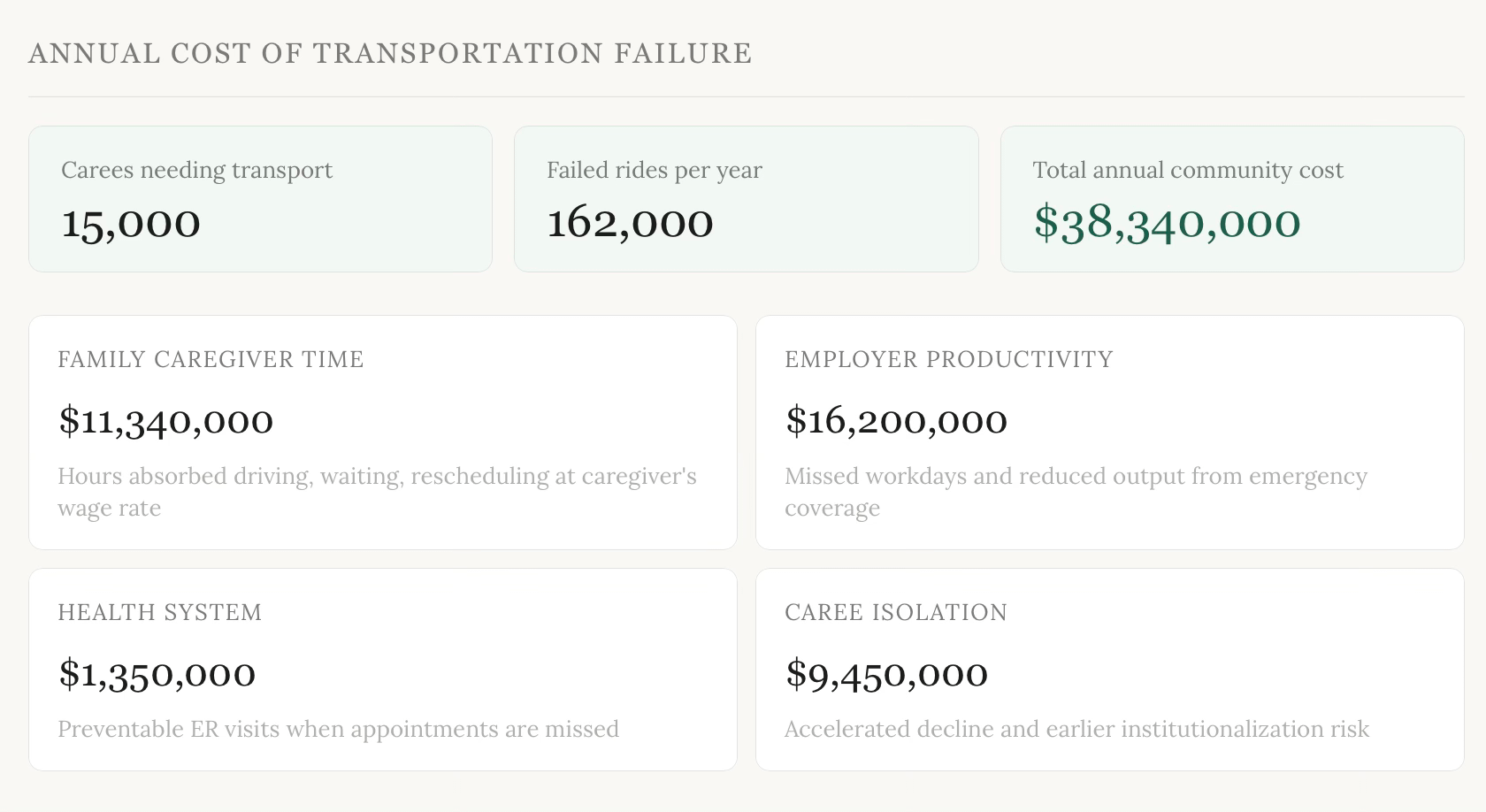
When public transportation fails, family caregivers become the default, absorbing costs in time, work, and health that no one is measuring. Until now.

She didn’t set out to become a transportation coordinator.
She became one anyway.
Her mother needed rides. Then her father-in-law gave up his keys. Then her disabled brother-in-law, who lives with her father-in-law, needed rides too. Three people. One family caregiver. An expanding radius of appointments, errands, and moments that require someone to show up with a car and the time to drive.
Her state technically provides transportation for seniors and people with disabilities. When it works, she says, the drivers are wonderful. But so often it doesn’t work. Drivers are underpaid. Many drive an hour from their own homes just to reach their first pickup. They have complicated lives — because underpaid people always do — and that complexity bleeds into rides that arrive late or don’t arrive at all.
So she fills the gap. She is the transportation.
Not just her time. Her brain. The mental load of managing transportation for three people — tracking schedules, anticipating failures, arranging backups, absorbing last-minute cancellations — is its own form of labor. It doesn’t show up in any economic model. It doesn’t get counted. But it costs her something every single day.
She is not an edge case. She is the system.
When public and paratransit systems fail, family caregivers become the default. They absorb the gap quietly, invisibly, at personal cost that no one is measuring. And they do it while managing everything else caregiving requires.
The drivers caught in this system face their own version of the same trap. Underpaid, commuting long distances to reach clients, navigating complicated lives on wages that don’t reflect the complexity of the work — they are, in many ways, the home health aide behind the wheel. The same distance between where they live and where they work. The same tax on their time and earnings, paid every single day.
Two broken systems. One family caregiver absorbing both.
Housing is a problem that, when addressed, solves so many other problems. Transportation is too.
How do you pay the price for the lack of transpiration options in your community?